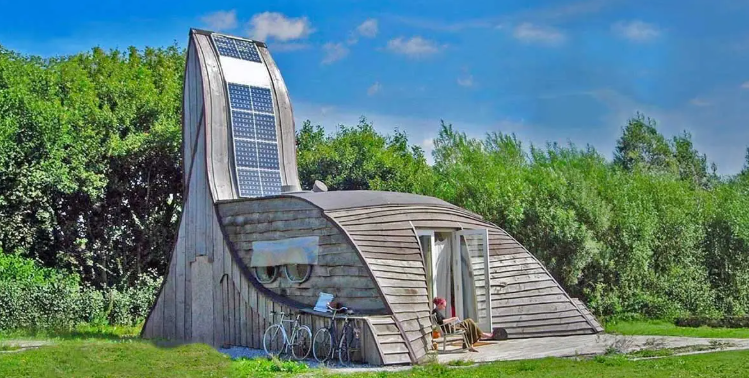
Two decades ago, a Scandinavian ecovillage emerged in Denmark’s countryside. A group of friends banded together to purchase a cheap cornfield, driven by a common goal of living debt-free and waste-free. Their goal was simple: to build a community centered on sustainable living. What started as a tiny business has grown into Friland.

In this thriving ecovillage, people live a back-to-basics lifestyle focused on community and environmental responsibility.The birth of Friland In 2002, thirteen families banded together with a daring vision: to build a village where sustainable living was not simply a concept, but a way of life. They pooled their finances and bought a large cornfield in Denmark—a wide, barren space without trees, buildings, or infrastructure.What began as a blank canvas evolved into Friland, a thriving Scandinavian ecovillage founded on collaboration, innovation, and self-sufficiency.
“We began here 22 years ago, in 2002. Steen Møller, one of the founders, described the area as a large field of maize with no trees or other vegetation. The families wished to abandon traditional markets and live debt-free, depending instead on local resources and alternative construction methods. Their goal was not only to survive, but also to establish a model of sustainable living that others may emulate.The initial stage in changing the empty land was to build dwellings, however Friland’s founders did not use typical construction methods.

Instead, they experimented with environmentally friendly materials such as straw bales, clay plaster, and seagrass, which were both inexpensive and sustainable. The original construction, currently the village’s common house, served as the pattern for their unusual approaches. “We erected the first building, now known as the common house, with paper walls, a straw roof, and newspaper insulation.
It wasn’t just about being eco-friendly—it was about proving that this could work,” Steen explained. Their designs emphasized creativity. One resident recalled how they used mussel shells, sourced for free from the seafood industry, as a foundation material. “Mussel shells are perfect for stopping humidity,” Steen told me. Though the shells are no longer free, they remain a testament to the community’s innovative spirit.

Their natural insulating properties, created by the air gaps between the shells, helped regulate indoor temperatures efficiently.As the Scandinavian ecovillage grew, sustainability became a cornerstone of every design choice. Green roofs, now common across the village, feature sedum plants instead of traditional grass. Sedum, a hardy, drought-resistant plant, thrives even in dry weather with minimal water.
“The humidity plants don’t need much water. Even in dry months, they thrive,” said the co-founder, highlighting the practical benefits of this approach. The village continues to inspire others, showing how people can live harmoniously with the earth while building a future that prioritizes both environmental care and human well-being.