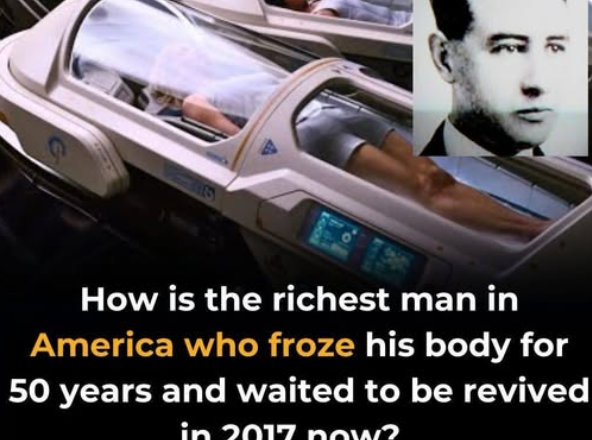
The doctors arrived at 2060 Eleanore Drive in Glendale, California, as James Bedford was gasping his last breaths. Bedford, aged 73, had terminal cancer. He had recently been transferred from a hospital to his neighbor’s home for hospice care. Dr. B. Renault Able appeared at Bedford’s deathbed at noon on Jan. 12, 1967, after the nurses informed him that his time was running out. Bedford mumbled, “I’m feeling better,” before quietly dying at 1:15 p.m.
Article continues below this advertisement. Okay, sort of. Bedford’s body is currently in a facility in Arizona, waiting for his second coming. He has been resting in a metal tube for almost 55 years, the first man in human history to be cryogenically frozen. The story is loaded with oddity, complexities, and, depending on your perspective on cryogenics, either misplaced optimism or inspiring hope.

Bedford was born in Pittsfield, Massachusetts, in the year 1893. He had his first brush with mortality when he was four years old, when he battled diphtheria for weeks and almost died. However, the boy healed and went on to live an adventurous and successful life. Bedford migrated to California as a young man and studied at UC Berkeley, where he earned his master’s degree in education while teaching high school in Escalon, a village in the San Joaquin Valley.
His primary interest was vocational training and job development, and he wrote several publications about the subject. “Many young people face the future with feelings of doubt, cynicism, and despair,” he told the Los Angeles Times in 1938, hoping to ease this. When he wasn’t assisting youngsters in finding rewarding vocations, Bedford traveled the world.
He went on safari in Africa, explored the rainforests of South America, and flew throughout Europe. Perhaps he wasn’t prepared for the trip to stop when he discovered he had cancer in his 70s. He started making calls to learn more about a new, fringe subject: human cryogenics. Bedford ultimately contacted President of the Cryonics Society of California, Robert Nelson, who was portrayed in some reports as a TV repairman. Nelson informed Bedford that his organization could offer the life-extending services he was looking for.
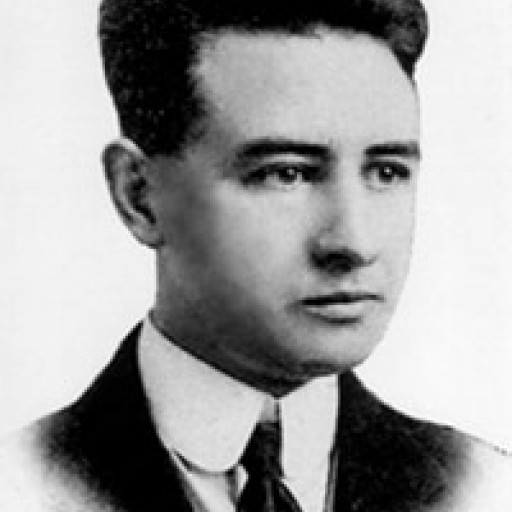
“He telephoned many times,” Nelson told the Associated Press, “and thought this process was the beginning and the end.” The Cryonics Society’s doctors had seven minutes from Bedford’s death to complete the first stage of his life. He was placed on artificial respiration to keep oxygen flowing to his brain, and dimethyl sulfoxide was injected into his veins to replace his blood and preserve his organs from freezing.
After that, he was placed on ice in a metal, tube-shaped capsule designed by — no joke – a Phoenix wigmaker named Ed Hope. The body was subsequently carried by hearse from a morgue in Los Angeles to the cryonics facility in Arizona. “We were sworn to secrecy about this,” an unnamed morgue worker told the Times. “We didn’t look into the container, but a doctor told us it held a body.”
A few days later, the Cryonics Society revealed to the world that the first human had been successfully frozen using liquid nitrogen and was ready for resuscitation once a cure for cancer was discovered. (Two of their prior attempts have failed. A San Francisco schoolteacher died too long before cryonics workers arrived, so even if he were awakened someday, his brain was likely too damaged to restore. Another case included a California woman who, unbeknownst to the Cryonics Society, had been embalmed before freezing. Once this was discovered, she was thawed out and buried as usual.
“Bedford can be preserved in suspended animation in his huge thermos bottle for 20,000 years, awaiting revival,” according to the newspaper. Scientists were doubtful. Dr. John Lyman, the head of UCLA’s biotech laboratory, described the study as “extremely naive” and “absurd.” “The metabolism of the cells breaks down and when even the small bodies have been cooled by liquid nitrogen, the cells burst and what you get out is something like a dishrag,” he told me.
Dr. Stanley Jacob of the University of Oregon, who co-discovered dimethyl sulfoxide, was not particularly enthused by its application. “I’m afraid that poor man’s funds have been wasted because it is not possible by present methods to do what they are attempting to do,” he was quoted as saying. “He’s dead once he’s frozen, and he’s not going to come back.” Article continues below this advertisement.
The hospice nurses who cared for Bedford were likewise skeptical. “Only God has the power of immortality,” one commenter said. Unfortunately, Bedford’s frozen sleep was far from restful. By 1970, the human thermos was not operating well; supposedly, the only way to tell if it was still refrigerated was to examine the tubes for frost. He was transferred to a new facility, but by 1976, that facility was likewise unable to perform the upkeep required for continued freezing.

So Bedford’s son Norman transported his father to a commercial cryonics facility in Emeryville in a U-Haul truck. On one occasion, Bedford’s daughter-in-law Cecilia posed for a picture with the tube. She appears carefree in her plaid suit, a cigarette dangling from her fingertips. He made his final move in 1991, when the cryonics business Alcor offered to take in the troubled man. After decades of moving, it was unclear what condition Bedford’s body would be in.
“I cannot describe the feeling of elation I had when I peeled back the sleeping bag that enclosed you and saw that you appeared intact and well cared for,” Alcor employee Mark Darwin wrote in 1991. “… Whatever else has happened, you have been frozen all these years. Few things in my life have fulfilled and elated me more than that knowing.”